
Redmi 17 5G Review: India Buyer Guide
A battery-first 5G phone with Snapdragon 4 Gen 5, 120Hz display, HyperOS 3 and a 7,900mAh battery.
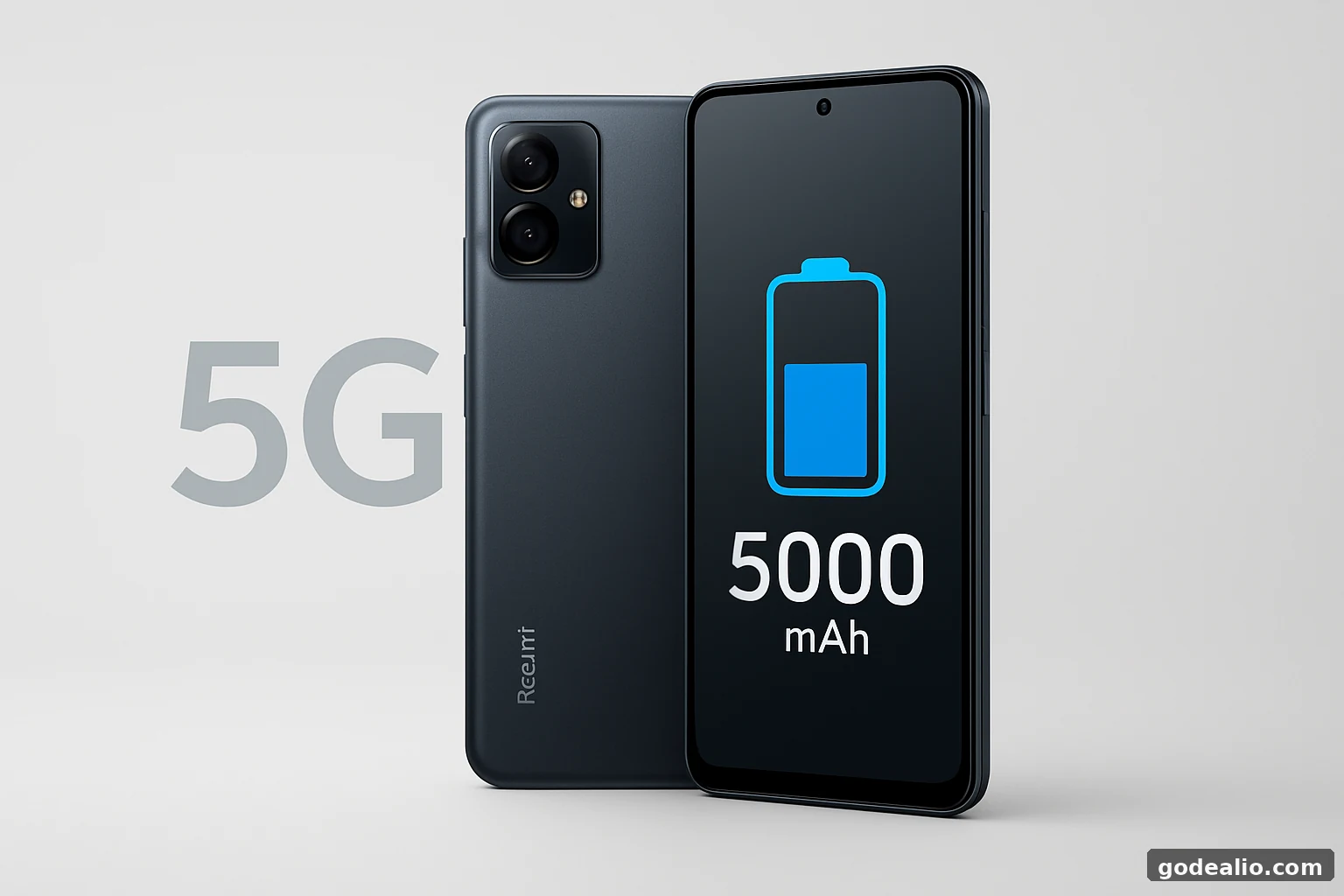
Redmi 17 5G is a battery-focused budget 5G phone for India with a 7,900mAh battery, Snapdragon 4 Gen 5, 6.9-inch 120Hz display, 50MP camera, HyperOS 3 and 45W charging. This review covers the confirmed specifications, India pricing, strengths, limitations and value.
Tracked price range. Retailer offers may change.
Launched in India; on sale through Amazon India from September 10, 2026.
Specification Highlights
Expert Review Notes
Review Score Breakdown
7,900mAh capacity, 45W turbo charging and 22.5W reverse wired charging are standout strengths.
Large 6.9-inch screen and 120Hz AdaptiveSync are excellent for everyday use, but HD+ resolution limits sharpness.
Snapdragon 4 Gen 5 on 4nm is appropriate for mainstream 5G use but is not designed as a performance-class gaming chip.
50MP main and 8MP selfie cameras cover essentials, but the auxiliary rear camera adds limited versatility.
HyperOS 3 on Android 16 with four OS generations and six years of security updates is unusually strong for the category.
IP64, Gorilla Glass 7i, side fingerprint sensor, stereo speakers and expandable storage are practical strengths; 232g weight is the drawback.
The feature set is broad, but pricing around ₹23,999-₹26,999 faces aggressive competition.
Excellent battery-first all-rounder with strong support and practical features, held back by HD+ resolution and modest performance headroom.
Pros
- Massive 7,900mAh battery is one of the strongest endurance-focused specifications in its segment.
- 45W wired charging plus up to 22.5W reverse wired charging adds useful everyday flexibility.
- 6.9-inch display supports up to 120Hz AdaptiveSync for smoother scrolling and UI movement.
- Snapdragon 4 Gen 5 uses a 4nm process and is well suited to mainstream 5G use, apps, media and light gaming.
- 50MP main camera, 8MP selfie camera, dual-camera recording and useful everyday camera modes.
- HyperOS 3 based on Android 16 with four years of OS updates and six years of security updates is a major software-strength for the segment.
- IP64 protection, Gorilla Glass 7i, stereo speakers, side fingerprint reader and microSD expansion strengthen the overall value.
Cons
- The 6.9-inch HD+ display is large and smooth but its resolution is not as sharp as Full HD+ alternatives.
- At 232 g and 8.8 mm thick, this is a large and heavy phone.
- Snapdragon 4 Gen 5 is designed for everyday performance rather than demanding flagship-level gaming.
- The secondary rear camera is basic, so buyers wanting versatile photography should look higher up the market.
- Current launch price around ₹23,999 places strong pressure on value because several rivals offer faster chipsets or sharper displays.
Quick verdict for Indian buyers
The Redmi 17 5G is now a much easier phone to judge than the earlier draft suggested because Xiaomi India has published the official product and specification pages. The headline is still the battery: 7,900mAh is unusually large for a mainstream 5G phone, and it is paired with 45W turbo charging and up to 22.5W reverse wired charging. For commuters, students, delivery workers and anyone who spends long periods away from a socket, that immediately gives the phone a clear reason to exist.
The rest of the package is built around practical everyday use rather than flagship ambitions. Snapdragon 4 Gen 5 provides mainstream 5G performance, the 6.9-inch display can run up to 120Hz, the phone has a 50MP main camera, HyperOS 3 based on Android 16, IP64 protection, Gorilla Glass 7i, stereo speakers and expandable storage. Those are useful features rather than marketing filler.
The biggest compromises are the HD+ resolution and performance ceiling. A 6.9-inch screen benefits from a sharper Full HD+ panel, while Snapdragon 4 Gen 5 is not intended to compete with performance-oriented Snapdragon 7-series or upper Dimensity chips. At current pricing, buyers should therefore decide whether battery size and long software support matter more than display sharpness and outright speed.
Godealio gives the Redmi 17 5G an 8.6/10 specification-based score. That score reflects the official hardware, support policy and India pricing context, while real-world battery, camera, gaming, thermal and network measurements are still pending.
India price, variants, and availability
Current India launch reporting places the 6GB+128GB Redmi 17 5G at ₹23,999 and the 8GB+128GB model at ₹26,999. Both variants use 128GB internal storage, while Xiaomi officially supports microSD expansion up to 2TB. That reduces the pressure to pay for a larger internal storage tier if your main need is storing photos, offline media and documents.
The price needs context. Around ₹24,000, Indian buyers can find phones with stronger processors, AMOLED or Full HD+ panels, or more versatile cameras. Redmi is asking buyers to value endurance, practical features and long support instead. That can work, but it means the phone is not an automatic value winner simply because its battery is enormous.
The 8GB model makes more sense for heavier multitasking, but its ₹3,000 premium should be compared against entirely different phones around ₹27,000. Memory extension can advertise up to 16GB on the 8GB version, but virtual memory uses storage and should not be treated as equivalent to 16GB of physical RAM.
The phone is available in Absolute Black, Endless Blue and Eternal Orange, and India availability began in September 2026 through Amazon. Always check the live selling price, card discounts and exchange offers because the effective price can move significantly after launch.
Design and build
The Redmi 17 5G is a physically large phone. Xiaomi lists dimensions of 170.12 × 78.42 × 8.8 mm and a weight of 232 g. That size is a direct consequence of the 6.9-inch display and 7,900mAh battery, and buyers should view it as an endurance/media device rather than a compact everyday handset.
Build protection is better documented than in the earlier draft. Xiaomi lists Corning Gorilla Glass 7i on the display and an IP64 rating for dust and splash resistance. IP64 does not make the phone suitable for intentional submersion, but it is reassuring for light rain, splashes and dusty daily environments when used within the manufacturer's stated limits.
The phone also includes Wet Touch technology, designed to keep the screen responsive with damp, oily or soapy fingers. That is a small but practical feature for Indian weather, kitchens, gyms and outdoor use. A side-mounted fingerprint sensor provides straightforward biometric unlocking.
Design is more expressive than many budget models because Redmi integrates a Dynamic RGB light around the camera area. It can show charging status, notifications, game lighting effects and camera-status indications. Buyers who dislike lighting effects can simply treat it as secondary; it does not change the core value proposition.
Display
The Redmi 17 5G uses a 17.53cm, or 6.9-inch, display with a refresh rate up to 120Hz. Xiaomi lists up to 240Hz touch sampling, DC dimming and 825 nits HBM brightness. TÜV Rheinland Low Blue Light, Flicker Free and Circadian Friendly certifications are also part of the display package.
The 120Hz capability is important because it improves scrolling and interface fluidity in supported apps. It also makes the phone feel more responsive than a basic 60Hz device even though the Snapdragon 4 Gen 5 is not a high-end processor. Adaptive behaviour can reduce refresh rate when maximum smoothness is unnecessary, helping balance fluidity and battery use.
The main compromise is resolution. Xiaomi positions the panel as HD+, not Full HD+. On a 6.9-inch screen, users who read fine text, inspect photos closely or sit near the display may notice lower pixel density compared with sharper rivals. Battery efficiency benefits from pushing fewer pixels, but visual sharpness is the trade-off.
Brightness at 825 nits HBM should be adequate for everyday outdoor use, but it is not a flagship-level sunlight specification. Godealio would still want to test direct sunlight visibility, colour accuracy and sustained brightness before making a laboratory judgement.
Performance and thermals
Snapdragon 4 Gen 5 is manufactured on a 4nm process and uses an octa-core CPU built around Cortex-A78 and Cortex-A55 cores with a maximum CPU frequency of 2.4GHz. The GPU is Adreno. This is a modern mainstream platform aimed at 5G efficiency, daily applications and ordinary multitasking rather than top-end gaming.
Xiaomi pairs the chipset with LPDDR4X memory and UFS 2.2 storage. The 6GB+128GB model should be sufficient for typical messaging, browsing, streaming, UPI, social networking and light multitasking. The 8GB variant gives more physical memory headroom and is the version to consider if you regularly keep many apps active.
Memory extension can increase the advertised memory figure to as much as 16GB on the 8GB model by using part of internal storage. It can help in some app-management scenarios, but storage-backed virtual memory is slower than physical LPDDR4X RAM and should not be compared directly with a phone containing 16GB of real RAM.
Thermal behaviour remains something that a specification sheet cannot settle. The 4nm process and modest performance target should help efficiency, but Godealio has not completed sustained CPU/GPU loops. Buyers who spend hours gaming should look for measured frame stability and temperatures rather than assuming that a newer chipset name guarantees gaming performance.
Gaming
The Redmi 17 5G can handle casual and moderate gaming, but it should not be positioned as a dedicated gaming phone. Snapdragon 4 Gen 5, the 120Hz panel and up to 240Hz touch sampling create a decent foundation for lighter competitive titles and general Android gaming.
In graphically demanding games, buyers should expect to reduce graphics settings rather than target maximum presets. The display's 120Hz refresh rate improves interface fluidity but does not mean every game will render at 120 frames per second. Frame rate is determined by the GPU, game optimisation, temperature and selected graphics settings.
The 7,900mAh battery is a major advantage for long sessions because it gives the phone more energy reserve than many rivals. However, battery size does not eliminate thermal limits or performance throttling. Real testing should measure average and low frame rates, surface temperature and battery loss after extended play.
The Dynamic RGB light includes gaming effects, which adds some visual personality but should not be mistaken for a performance feature. Buyers whose first priority is gaming should compare processor class before battery capacity.
Camera and video
The rear camera system is centred on a 50MP main camera with a 5P lens and f/1.8 aperture, accompanied by an auxiliary lens. Xiaomi provides FilmCamera, HDR, Night mode, Auto Night mode, Portrait mode, Time-lapse, Dual Camera Recording and Document mode.
The 50MP specification is useful for resolution, but megapixel count alone cannot predict image quality. Sensor size, optics, processing, shutter behaviour and HDR tuning matter just as much. Godealio has not completed direct daylight, low-light or moving-subject testing, so this remains a specification-based camera assessment.
The absence of a dedicated ultrawide or telephoto lens limits photographic flexibility. If you frequently shoot architecture, landscapes or distant subjects, a competitor with a useful ultrawide or optical telephoto may be a better choice even if its headline battery capacity is smaller.
The 8MP front camera uses an f/2.05 aperture and supports HDR, a soft-light ring, Portrait, Time-lapse, Night mode and Dual Camera Recording. It should cover video calls and ordinary social use, but selfie detail and skin-tone processing need real samples before receiving a strong camera score.
Dual-camera recording can be useful for travel, interviews and reaction-style content because it captures front and rear perspectives. It is a practical creator feature at this price, though the phone is still better viewed as a battery-centric all-rounder than a camera-focused device.
Battery and charging
The 7,900mAh battery is the defining specification of the Redmi 17 5G. Xiaomi describes it as capable of up to 2.5 days of battery life under its test conditions, with marketing figures including more than 20 hours of video playback, up to 146 hours of music playback, around 10 hours of video recording and up to 53 hours of calling.
Those are manufacturer figures and should not be confused with independent mixed-use measurements. Real Indian usage can include 5G, navigation, high brightness, WhatsApp, Instagram, YouTube, UPI apps, camera use, hotspot sharing and poor-signal environments. Those workloads can substantially change battery endurance.
Charging reaches 45W, and Xiaomi includes a charger in the box. The company advertises roughly 96 minutes for a full charge and about 35 minutes to obtain what it calls an all-day level of power under its internal conditions. That is not exceptionally fast for the price class, but it is sensible given the unusually large battery.
Up to 22.5W reverse wired charging is one of the most useful extras. The Redmi 17 5G can act like a power bank for earbuds, a smartwatch or another phone in an emergency. For travellers and field workers, that makes the battery more useful than a simple large-capacity number.
Xiaomi also says the battery can retain at least 80% of its original capacity after 1,000 full charging cycles under its laboratory conditions. Long-term real-world degradation varies by heat, charging habits and workload, but the published cycle target is encouraging.
Software and update policy
The Redmi 17 5G runs HyperOS 3 based on Android 16. That resolves one of the biggest uncertainties in the original draft. Xiaomi also advertises a 48-month like-new software experience, indicating optimisation aimed at resisting performance degradation through extended regular use.
More importantly, Xiaomi states that the Redmi 17 5G is backed by four years of OS updates and six years of security updates. For a mainstream Redmi phone, that is a strong support commitment and materially improves long-term value for buyers who keep devices beyond the normal two- or three-year replacement cycle.
HyperOS 3 includes Xiaomi HyperIsland and the usual Xiaomi ecosystem integration. Buyers should still review permissions, notifications, recommendation settings and any preloaded applications during setup because the exact retail software package can vary.
Software support is one of the reasons this phone deserves a higher score than a specification-only battery device. A huge battery is useful on day one, but long updates determine whether banking, UPI, security and application compatibility remain comfortable years later.
5G, calls, GPS, and connectivity in India
The Redmi 17 5G is officially sold as a 5G smartphone in India and supports dual-SIM operation. Xiaomi's regional product material also lists modern connectivity features including NFC in supported configuration, while standard Android functions such as VoLTE and Wi-Fi calling are expected for Indian carrier use.
For Jio and Airtel users, actual experience depends on the exact supported bands, local tower deployment, signal strength and software modem tuning. Godealio has not performed carrier-specific testing, so it would be misleading to claim superior reception from the specification sheet alone.
The large battery makes the phone particularly attractive for hotspot use, navigation and long mobile-data sessions. Those workloads are often punishing on ordinary phones because both modem activity and screen brightness consume substantial power.
Before buying for a specialist network requirement, verify the live Xiaomi India specification for exact bands and carrier features. Mainstream users can reasonably expect ordinary Indian 5G functionality, but procurement or enterprise buyers should always confirm exact radio requirements.
Audio, biometrics, and daily usability
Daily-use hardware is more complete than the original draft suggested. Xiaomi equips the Redmi 17 5G with dual stereo speakers and advertises up to 300% super-volume mode with Xiaomi Sound tuning. That is useful for calls, podcasts and video in noisy environments, although maximum-volume clarity still needs hands-on testing.
A side-mounted fingerprint sensor provides fast, familiar authentication. The phone also includes IP64 protection and Wet Touch support, both of which improve everyday practicality. These details matter because they are used constantly, unlike some headline specifications that are rarely noticed after setup.
Expandable microSD storage up to 2TB is another practical advantage. Users with large offline music, video or photo collections can expand capacity without paying for a higher internal-storage variant. UFS 2.2 internal storage should still be used for applications and performance-sensitive files.
The biggest usability drawback is physical size. At 232 g and 170.12 mm tall, the Redmi 17 5G is not ideal for users who want a compact phone. A case makes it larger still, so buyers should prioritise the endurance and viewing benefits enough to accept that trade-off.
Alternatives
The Redmi 17 5G should be compared with current phones around ₹20,000 to ₹27,000 rather than with much older Redmi devices alone. The right comparison depends on your priority: battery size, AMOLED/Full HD+ display quality, chipset speed, camera versatility or software support.
If battery endurance is the overwhelming priority, few mainstream phones can match the appeal of a 7,900mAh pack combined with reverse charging. If display quality is more important, look for a Full HD+ AMOLED rival even if its battery is smaller.
Performance-first buyers should compare Snapdragon 4 Gen 5 with Snapdragon 6/7-series and upper Dimensity alternatives at the same effective street price. Camera-first buyers should look for a genuine ultrawide, OIS-equipped main sensor or telephoto capability rather than relying only on a 50MP headline.
Godealio's existing Redmi product pages, mobile review hub, comparison pages and buying guides should be used together rather than selecting a phone from a single specification. Price movements after launch can easily change which device is the better value.
Pros and cons at a glance
The strongest advantages are endurance, charging flexibility, software support and everyday practicality. A 7,900mAh battery with 45W charging, a charger in the box and 22.5W reverse charging is a powerful combination. IP64, Gorilla Glass 7i, stereo speakers, microSD expansion and a side fingerprint sensor make the phone feel complete rather than stripped down.
The disadvantages centre on display sharpness, performance ceiling and camera flexibility. HD+ resolution is modest for a 6.9-inch panel, Snapdragon 4 Gen 5 is not a gaming-first chip, and the auxiliary rear camera does not provide the versatility of a true ultrawide or telephoto.
Price decides whether those trade-offs are acceptable. At roughly ₹23,999, the 6GB model asks buyers to prioritise battery and support. At ₹26,999, the 8GB version enters more competitive territory, so checking current discounts and rival specifications is essential.
Final verdict
The Redmi 17 5G is one of the clearest examples of a battery-first smartphone. Xiaomi has built the product around a 7,900mAh battery, then added enough practical hardware around it — 45W charging, reverse charging, 120Hz display, stereo speakers, IP64 protection, Gorilla Glass 7i, microSD expansion and long software support — to make the battery advantage genuinely useful.
It is not the best phone for every buyer. The 6.9-inch HD+ panel is less sharp than Full HD+ rivals, Snapdragon 4 Gen 5 is mainstream rather than high-performance, and the camera system lacks multiple strong focal lengths. Those compromises are understandable, but buyers should know exactly what they are trading for endurance.
At current India launch pricing, Godealio rates the Redmi 17 5G 8.6/10 on specifications and positioning. It is an excellent shortlist option for battery-focused users and long-term practical ownership. Performance gamers and camera enthusiasts should compare alternatives before purchasing, and the score should be revisited when Godealio has completed hands-on battery, thermal, gaming and camera tests.
Decision Snapshot
- Battery endurance is your first priority and you want a phone that can comfortably stretch through heavy daily use.
- You prefer a very large display for video, reading, social media and navigation.
- You want long software support, expandable storage, stereo speakers and IP64 protection in one package.
- You value reverse wired charging for accessories or emergency top-ups.
- You want a sharper Full HD+ or AMOLED display.
- You are buying mainly for heavy gaming or sustained high-frame-rate performance.
- You want a strong ultrawide or telephoto camera rather than a basic auxiliary rear sensor.
- You prefer a compact or lightweight phone.
- Verify current Amazon India pricing because launch offers can change effective value.
- Compare the 6GB and 8GB variants; both have 128GB internal storage, with microSD expansion available.
- If gaming matters, compare Snapdragon 4 Gen 5 against faster chipsets available around the same street price.
- Check whether the HD+ resolution is sharp enough for your preferences on a 6.9-inch panel.
Review Disclosure
Display Analysis
- HD+ resolution is less sharp than Full HD+ panels at this large 6.9-inch size.
- This is not positioned as an AMOLED display.
Performance Analysis
- Snapdragon 4 Gen 5 is not a gaming-flagship processor.
- No independent Godealio benchmark loop or throttling data is available yet.
Gaming Analysis
- Popular Android titles should run according to their device compatibility and graphics settings; title-specific verification is pending.
Camera Analysis
- The auxiliary rear camera offers much less flexibility than a dedicated ultrawide or telephoto.
- Godealio has not yet completed retail-unit photo and video testing.
Battery Analysis
- Manufacturer battery claims depend on Xiaomi test conditions.
- Real-world mixed-use endurance and charging temperatures remain to be independently tested.
Software Support
- Xiaomi HyperIsland and software features included with HyperOS 3; feature availability can vary by build.
Network Support
India Usage
- Street pricing and bank offers can change quickly.
- Network quality varies by operator, location and spectrum deployment.
Variants
Box Contents
- Redmi 17 5G
- 45W charger
- USB Type-C cable
- SIM eject tool
- Protective case
- Documentation
Dimensions And Weight
Water Dust Resistance
Biometrics
Audio
Alternatives
Final Verdict
Redmi 17 5G succeeds most clearly as a practical endurance phone. The 7,900mAh battery, 45W charging, 22.5W reverse wired charging, 120Hz display, HyperOS 3, long software-support promise, stereo speakers, IP64 rating and expandable storage give it a broad feature set for everyday Indian use. The compromises are equally easy to understand: Snapdragon 4 Gen 5 is a mainstream chipset, the display is HD+ rather than Full HD+, and the camera system is built around a single useful 50MP main sensor rather than multiple strong focal lengths. At around ₹23,999 for 6GB+128GB and ₹26,999 for 8GB+128GB, value is reasonable but not unbeatable. Buyers prioritising battery endurance, media consumption and long support should shortlist it; performance-first and camera-first buyers should compare alternatives carefully.
FAQs
What is the Redmi 17 5G price in India?
Current India launch pricing is reported at ₹23,999 for 6GB+128GB and ₹26,999 for 8GB+128GB. Check the live Amazon/Xiaomi price for current offers.
How big is the Redmi 17 5G battery?
Xiaomi officially lists a 7,900mAh typical battery with 45W turbo charging and up to 22.5W reverse wired charging.
Which processor does Redmi 17 5G use?
It uses Qualcomm Snapdragon 4 Gen 5, a 4nm octa-core platform with CPU speeds up to 2.4GHz.
Does Redmi 17 5G have a 120Hz display?
Yes. The 6.9-inch HD+ display supports AdaptiveSync refresh rates up to 120Hz and touch sampling up to 240Hz.
Which Android version is on Redmi 17 5G?
The India model runs Xiaomi HyperOS 3 based on Android 16.
How long will Redmi 17 5G receive updates?
Xiaomi India states four years of OS updates and six years of security updates for the Redmi 17 5G.
Is Redmi 17 5G waterproof?
It has an IP64 rating for dust and splash resistance. That is useful for everyday splashes and light rain but it is not intended for deliberate submersion.
Is Redmi 17 5G good for gaming?
It is suitable for casual and moderate gaming, but Snapdragon 4 Gen 5 is a mainstream efficiency-focused chip rather than a dedicated high-performance gaming platform.
Does Redmi 17 5G support expandable storage?
Yes. Xiaomi lists microSD expansion up to 2TB in addition to 128GB internal storage.
Should I buy Redmi 17 5G?
It is a strong choice if battery life, a big screen, long update support and practical features are your priorities. If you want a sharper AMOLED display, faster gaming performance or a more versatile camera system, compare alternatives first.