
Windows Laptops Are Entering Their MacBook Neo Era, But Is Windows 11 Actually Ready for It? 8GB of RAM Has Me Worried
AI-powered Windows laptops are finally matching MacBooks in battery life and efficiency, but many manufacturers are still shipping systems with only 8GB RAM.
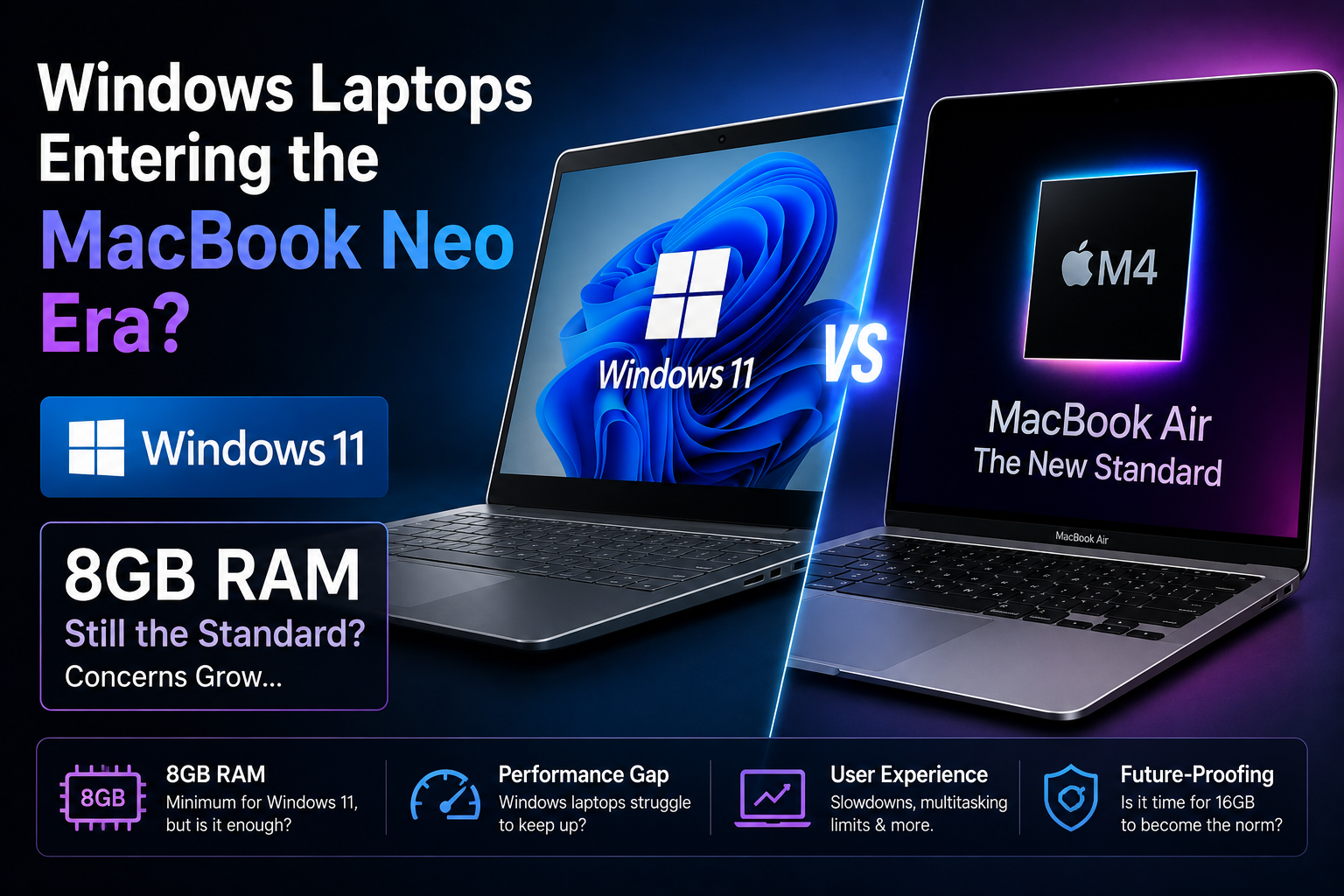
Windows laptops are undergoing a major transformation. Thanks to Snapdragon X Elite, Intel Lunar Lake, AMD Ryzen AI processors and Microsoft's Copilot+ PC initiative, modern Windows machines now deliver battery life and efficiency previously associated with MacBooks. However, the continued reliance on 8GB RAM in many models raises concerns about long-term Windows 11 performance, AI workloads and future software requirements.
Brand
Microsoft
Model
Windows 11 Ecosystem
Topic
Windows Laptops
Content Type
opinion_analysis
Rating
8.7
Specification Highlights
Label
Operating System
Value
Windows 11
Label
AI Platform
Value
Copilot+ PC
Label
Recommended RAM
Value
16GB Minimum
Label
Processor Platforms
Value
Snapdragon X Elite, Intel Lunar Lake, AMD Ryzen AI
Label
Storage Recommendation
Value
512GB SSD or Higher
Label
Target Audience
Value
Students, Professionals, Creators
Pros
- Modern Windows laptops offer significantly improved battery life
- Premium designs rival Apple's MacBook lineup
- AI-powered productivity features are expanding rapidly
- Better efficiency from ARM and next-generation x86 processors
- Improved standby performance and instant wake support
- Greater competition benefits consumers
Cons
- Many models still ship with only 8GB RAM
- AI workloads may increase memory requirements
- Windows 11 is becoming more resource intensive
- Many ultrabooks use non-upgradable soldered memory
- Future-proofing concerns for long-term buyers
Final Verdict
Windows laptops have never been more competitive against MacBooks. Battery life, efficiency, build quality and AI features are improving rapidly. However, manufacturers continuing to offer 8GB RAM configurations in 2026 risk undermining the long-term user experience. For most buyers, 16GB RAM should now be considered the practical minimum.
Windows Laptops Are Finally Changing
For years, MacBooks enjoyed a major advantage in battery life, efficiency and overall user experience. While Windows laptops often offered stronger specifications on paper, many struggled to match Apple's refinement.
That situation is finally changing in 2026. A new generation of Windows laptops is delivering dramatically better battery life, quieter operation, faster wake times and more premium designs.
For the first time in a long time, many Windows laptops genuinely feel like serious MacBook competitors.
The MacBook Influence Is Everywhere
Many premium Windows laptops now prioritize efficiency over raw benchmark numbers.
Manufacturers are focusing on all-day battery life, lightweight aluminum chassis, OLED displays and instant-on functionality.
The result is a category of Windows devices that feels much closer to Apple's successful MacBook formula.
- Longer battery life
- Premium metal construction
- Improved standby efficiency
- Thin and lightweight designs
- Better display quality
The Rise of AI PCs
Microsoft's Copilot+ PC initiative represents one of the biggest changes to Windows hardware in years.
AI-powered search, productivity assistants, image generation, content creation tools and local machine-learning features are becoming central parts of the Windows experience.
Manufacturers are increasingly marketing laptops around AI capabilities rather than traditional specifications.
- Copilot integration
- Local AI processing
- Enhanced productivity tools
- AI-assisted content creation
- Future AI software support
The 8GB RAM Problem
Despite all these improvements, one specification continues appearing far too often: 8GB RAM.
While 8GB remains technically usable for light workloads, Windows 11 is far more demanding than previous versions of Windows.
Modern browsers, cloud synchronization tools, collaboration software, AI assistants and background services can quickly consume available memory.
- Chrome and Edge can consume several gigabytes of RAM
- Teams and Zoom increase memory usage
- AI tools require additional resources
- Background services continue growing
- Windows updates rarely reduce requirements
What Happens in Real-World Usage?
Most users rarely run a single application at a time.
Students may have multiple browser tabs, Microsoft Office applications, messaging apps and video calls running simultaneously.
Professionals often juggle dozens of tabs, spreadsheets, presentations and collaboration tools.
Under these conditions, 8GB RAM can become a noticeable bottleneck.
The Future-Proofing Concern
Many consumers keep laptops for four to six years.
A laptop that feels responsive today may become noticeably slower as software requirements increase.
Unlike storage, memory often cannot be upgraded later, especially in modern ultrabooks that use soldered RAM.
- Long-term ownership concerns
- Limited upgrade options
- Growing software requirements
- Increasing AI workloads
Why 16GB Should Be the New Standard
In 2026, 16GB RAM provides a much more comfortable experience for most users.
It allows smoother multitasking, better browser performance and improved responsiveness under heavy workloads.
For buyers investing in a laptop intended to last several years, the extra memory is often one of the most valuable upgrades available.
- Better multitasking
- Improved longevity
- Stronger AI performance
- Reduced slowdowns
- More consistent responsiveness
Who Should Consider 32GB RAM?
Developers, content creators, engineers and power users may benefit from 32GB RAM configurations.
Video editing, virtualization, software development and AI workloads can easily take advantage of additional memory.
These users are often better served by investing in more RAM rather than a slightly faster processor.
Windows vs MacBook in 2026
The gap between Windows laptops and MacBooks has narrowed dramatically.
Battery life, display quality and efficiency are now highly competitive.
Windows retains advantages in software compatibility, gaming support and hardware diversity.
The remaining challenge is ensuring that entry-level configurations remain viable for long-term ownership.
Final Thoughts
Windows laptops are entering what many would describe as their MacBook era.
Battery life is improving, AI capabilities are expanding and premium designs are becoming more common.
However, manufacturers continuing to ship 8GB RAM systems risk creating devices that age faster than consumers expect.
For most buyers in 2026, 16GB RAM should be viewed as the practical starting point rather than a premium upgrade.
FAQs
Is 8GB RAM enough for Windows 11 in 2026?
It is usable for basic workloads, but 16GB RAM is strongly recommended for long-term ownership and multitasking.
Why are AI PCs increasing memory requirements?
AI features run alongside traditional applications and often require additional memory for local processing and background tasks.
Should students buy 8GB or 16GB laptops?
Students planning to keep a laptop for multiple years should prioritize 16GB RAM whenever possible.
What RAM size is recommended for creators?
Content creators should ideally choose 16GB or 32GB RAM depending on their workload.
Are Windows laptops finally competing with MacBooks?
Yes. Modern Windows laptops now offer competitive battery life, efficiency and premium hardware experiences.