
The Traditional Patch Window Is Officially Dead as AI Finds Bugs Faster Than Humans Can Fix Them
AI-powered vulnerability discovery is accelerating cybersecurity beyond human patching speed, forcing companies to rethink how software security works.
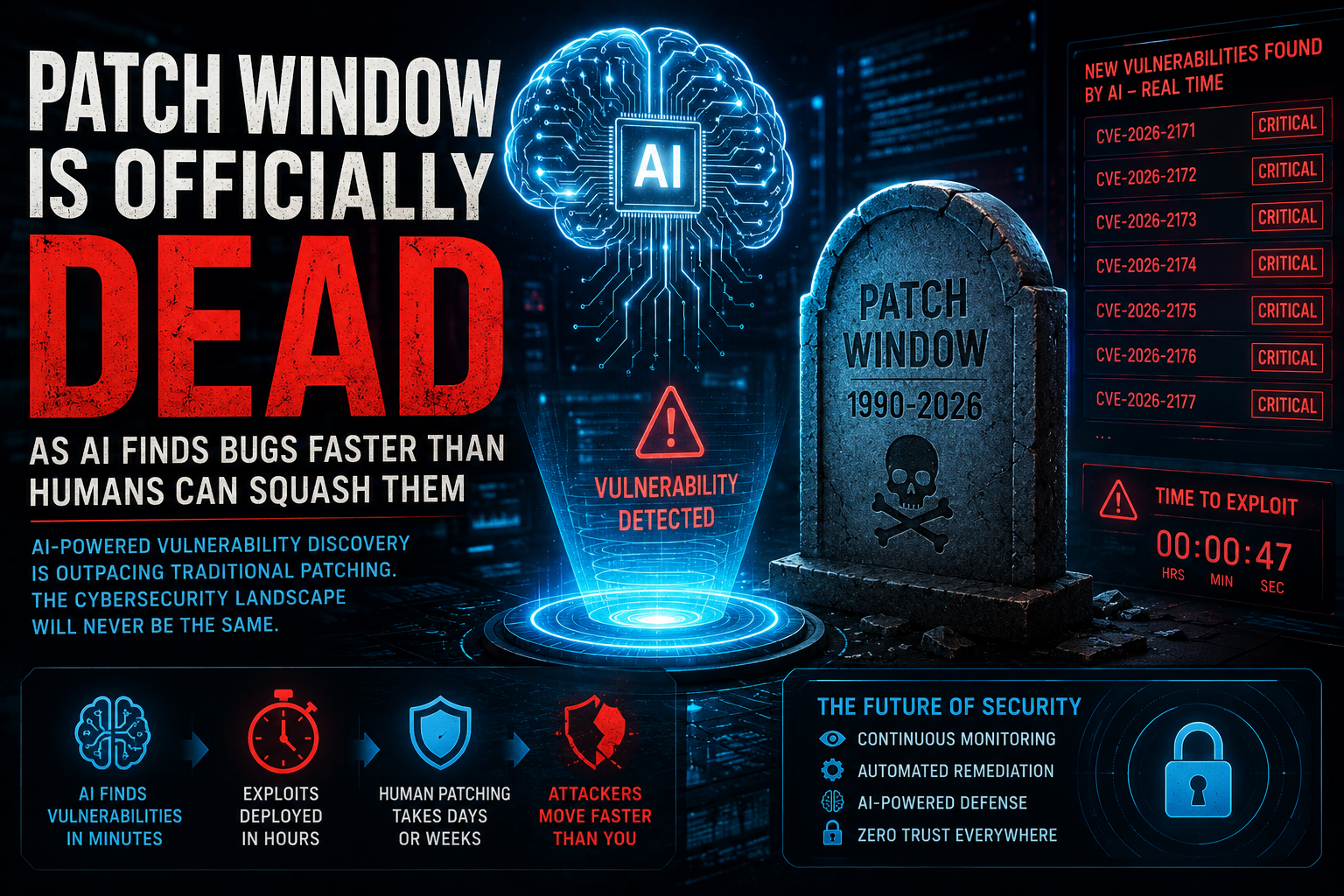
The traditional ‘patch window’ model in cybersecurity is rapidly collapsing as AI systems discover software vulnerabilities faster than security teams can fix them. Security researchers warn that AI-assisted bug hunting is dramatically shrinking the time between vulnerability discovery and real-world exploitation.
Brand
AI Security
Model
AI Vulnerability Discovery
Launch Status
Industry shift
Availability
Global cybersecurity impact
Rating
9.1
Specification Highlights
Label
Core Trend
Value
AI-driven vulnerability discovery
Label
Biggest Impact
Value
Shorter exploit timelines
Label
Traditional Model
Value
Scheduled patch windows
Label
Emerging Model
Value
Continuous remediation
Label
Main Concern
Value
AI-assisted cyberattacks
Label
Enterprise Need
Value
Automated security response
Pros
- AI can identify vulnerabilities much faster
- Improves automated security scanning
- Helps security teams detect issues earlier
- Can reduce manual bug-hunting workload
- Accelerates large-scale code analysis
Cons
- Attackers can also use AI for exploitation
- Patch cycles are becoming too slow
- Security teams face constant pressure
- Traditional patch management models are failing
- More zero-day vulnerabilities may appear
Final Verdict
AI is fundamentally changing cybersecurity. The old idea of monthly patch windows and slow remediation cycles no longer matches the speed of AI-driven vulnerability discovery. Companies may need continuous patching, automated mitigation, and AI-assisted defense systems to keep up.
Why the Patch Window Is Dying
For decades, enterprises relied on scheduled patch windows to update systems safely and predictably.
That model is now under pressure because AI systems can identify vulnerabilities at a speed human security teams cannot match.
The time between discovering a vulnerability and exploiting it is shrinking dramatically.
AI Can Find Bugs Faster Than Humans
Modern AI systems can analyze huge codebases in minutes and detect patterns linked to security flaws.
Tasks that previously required weeks of manual research can now happen almost instantly.
This includes identifying insecure APIs, authentication flaws, memory handling problems, and misconfigurations.
- Automated code analysis
- Pattern-based vulnerability detection
- Faster fuzzing and exploit generation
- Large-scale software scanning
Attackers Benefit Too
The same AI tools helping defenders can also help attackers.
Cybercriminals can use AI to automate reconnaissance, generate exploit variations, and search for weak targets at scale.
This creates a dangerous imbalance when organizations still rely on slow patch approval processes.
- AI-assisted exploit discovery
- Faster attack automation
- More scalable phishing operations
- Shorter time-to-exploit
Monthly Patch Cycles No Longer Work
Traditional monthly or quarterly patch schedules were designed for a slower threat landscape.
Today, some vulnerabilities can move from discovery to exploitation within hours.
Organizations waiting weeks for maintenance windows may already be exposed before updates are deployed.
The Shift Toward Continuous Security
Security teams are increasingly moving toward continuous patching and automated remediation.
Instead of waiting for fixed maintenance windows, modern infrastructure may need real-time mitigation systems.
Cloud-native architectures and containerized deployments make faster patching more realistic than older enterprise environments.
- Continuous vulnerability scanning
- Automated patch deployment
- AI-assisted threat monitoring
- Runtime security controls
Why Enterprises Are Struggling
Large organizations often cannot patch systems instantly because of compatibility testing, regulatory requirements, and uptime concerns.
Critical production systems may depend on legacy applications that break easily after updates.
This creates tension between operational stability and cybersecurity urgency.
The Growing Zero-Day Problem
AI may increase the number of zero-day vulnerabilities discovered every year.
As AI models become more capable, both researchers and attackers may uncover hidden flaws much faster than before.
This could overwhelm traditional incident response and vulnerability management teams.
What This Means for DevOps and Engineering Teams
Security can no longer remain a separate step after development.
Modern DevSecOps workflows will likely require AI-assisted code reviews, automated dependency scanning, and continuous monitoring integrated directly into CI/CD pipelines.
The future may involve AI defending systems against other AI systems.
- AI-powered CI/CD security checks
- Automated dependency monitoring
- Runtime anomaly detection
- Infrastructure-as-code security validation
The Future of Cybersecurity
Cybersecurity is shifting from reactive patching to proactive continuous defense.
Organizations may need systems capable of self-monitoring, automated isolation, and AI-driven remediation.
The old patch-window mindset is being replaced by an always-on security model.
Final Thoughts
The real story is not just that AI finds bugs faster.
It is that cybersecurity timelines are collapsing.
Companies still operating with slow patch cycles and manual review processes may struggle to keep pace with AI-powered threats in the coming years.
FAQs
What is a patch window?
A patch window is a scheduled maintenance period when organizations deploy software updates and security fixes.
Why are patch windows becoming less effective?
AI systems can now discover and help exploit vulnerabilities much faster, shrinking the safe response time available to defenders.
Can AI help cybersecurity defenders too?
Yes. AI can improve vulnerability scanning, threat detection, incident response, and automated remediation.
What is continuous patching?
Continuous patching refers to deploying updates and security mitigations continuously instead of waiting for fixed maintenance schedules.
Will AI increase cyberattacks?
AI may increase the speed and scale of cyberattacks because attackers can automate reconnaissance, exploit generation, and phishing workflows.