
What Is Refresh Rate & Does 120Hz Really Matter?
60Hz vs 90Hz vs 120Hz displays explained — gaming, battery impact, and who actually needs it.
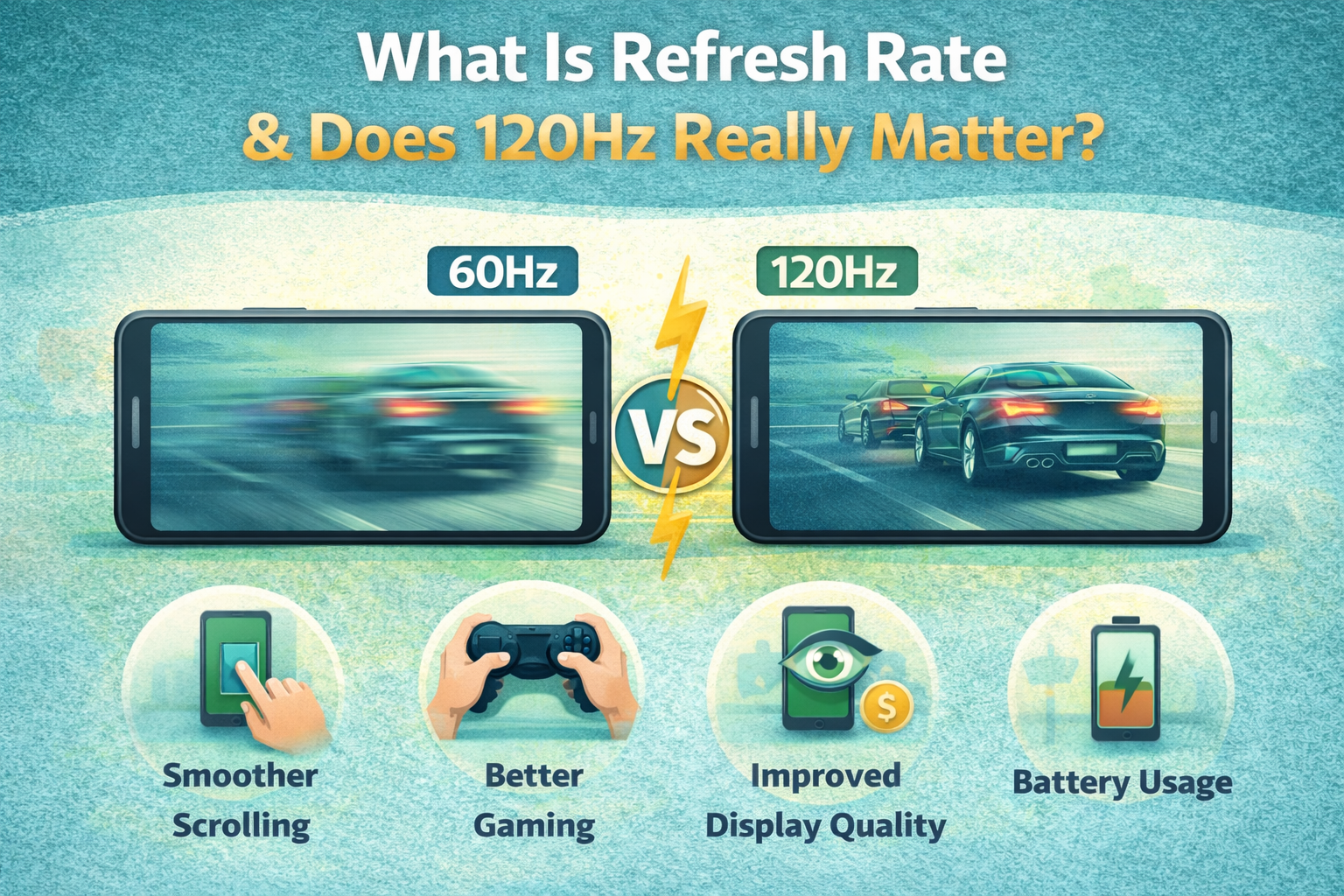
A simple explanation of mobile display refresh rates and whether higher refresh rates like 120Hz are worth paying for.
Comparison Advice
- Compare final checkout price, not only MRP.
- Compare the same RAM and storage variant.
- Check return window and warranty activation.
- Shortlist 2-3 alternatives before buying.
Mistakes to Avoid
- Buying only because of high megapixel count.
- Ignoring storage variant and expandable storage support.
- Ignoring charger availability in the box.
- Not checking 5G bands and service support.
Deal Advice
- Wait for bank offers if the phone is newly launched.
- Use exchange only when the old phone value is fair.
- Check both Amazon and Flipkart before final purchase.
- Avoid unknown sellers even if the price looks lower.
What Is Refresh Rate?
Refresh rate refers to how many times per second a phone’s display updates the image.
It is measured in Hertz (Hz). For example, a 60Hz screen refreshes 60 times per second.
1. Common Refresh Rates on Smartphones
- ✔ **60Hz:** Standard on budget phones
- ✔ **90Hz:** Smoother scrolling and animations
- ✔ **120Hz:** Ultra-smooth experience for gaming and UI
- ✔ **144Hz+:** Rare, mainly gaming-focused phones
2. What Difference Does Higher Refresh Rate Make?
Higher refresh rates make scrolling smoother, animations cleaner, and gameplay more responsive.
The difference is most noticeable when scrolling social media, browsing, or playing fast-paced games.
3. Does 120Hz Matter for Gaming?
- ✔ Competitive games feel smoother
- ✔ Reduced motion blur
- ✔ Faster touch response perception
- ✖ Only games supporting high FPS benefit
- ✖ Requires powerful processor to sustain performance
Godealio buying framework
This guide is built to help Indian buyers make a practical decision on what is refresh rate & does 120hz really matter? without relying only on marketing claims.
Before buying, compare the final checkout price, RAM and storage variant, warranty coverage, bank offer, exchange value and seller rating.
- Check the exact model number and storage variant.
- Prefer higher storage if you plan to keep the phone for 3 years or more.
- Do not judge camera quality only by megapixels.
- Compare final effective price after bank and exchange offers.
Who should use this guide?
This page is useful for buyers who want a simple shortlist, not just a long specification table.
The recommendations are grouped by real-world use cases such as camera, battery, gaming, display, software support and long-term ownership.
Deal checklist before purchase
- Confirm the seller is trusted and return policy is available.
- Check whether charger, cable or case is included in the box.
- Check 5G band support if you use Jio or Airtel 5G.
- Read recent reviews for heating, battery drain and camera issues.
- Compare Amazon and Flipkart prices before ordering.
Frequently Asked Questions
Is 120Hz better than 60Hz?
Yes, it feels smoother, but the benefit depends on usage and app support.
Does higher refresh rate affect battery?
Yes. Higher refresh rates consume more power, especially without adaptive refresh technology.
Is 90Hz good enough?
For most users, 90Hz offers a noticeable improvement over 60Hz with less battery impact.
Does What Is Refresh Rate Does 120Hz Matter really matter while buying a phone?
It matters only if it improves your daily usage. Compare it with battery, performance, display, camera and software support before deciding.
Should I pay extra for this feature?
Pay extra only if the feature directly improves your use case, such as gaming, photography, video recording, travel or long-term use.
What should beginners check first?
Beginners should first check price, battery, display quality, processor, storage, warranty and service support.
How should I choose from what is refresh rate & does 120hz really matter??
Start with your budget and main use case, then compare battery, camera, storage, software support, service network and final checkout price.
Should I wait for sale offers before buying?
Yes, if the phone is not urgent. Bank discounts, exchange bonuses and festive sale prices can change the value significantly.
What is the safest storage option for long-term use?
For most users, 128GB is the minimum practical option. Heavy camera, video and gaming users should prefer 256GB or higher.
Related Reading on Godealio
- Best gaming phones
- Compare mobiles
- Compare phones
- Latest mobile offers
- All mobile guides
- All mobiles
- OPPO K14x 5G Review (2026): Battery Beast Under ₹15,000 with Smooth 120Hz Display
- Samsung Galaxy A27 5G Launched in India with Gemini AI, 120Hz AMOLED Display and 6 Years of Updates
- Samsung Galaxy A27 5G Launched in India: Snapdragon 6 Gen 3, 120Hz AMOLED Display, Galaxy AI and 6 Years of Updates
- Nothing Phone (4b) Full Specifications Leaked: Snapdragon 6 Gen 4, 120Hz AMOLED, Android 16 and July 7 Launch
- AI Features That Actually Matter
More Guide Details
Featured
false