
How to Understand RAM, Storage and Chipsets
Understand the basics so spec sheets stop feeling like a foreign language.
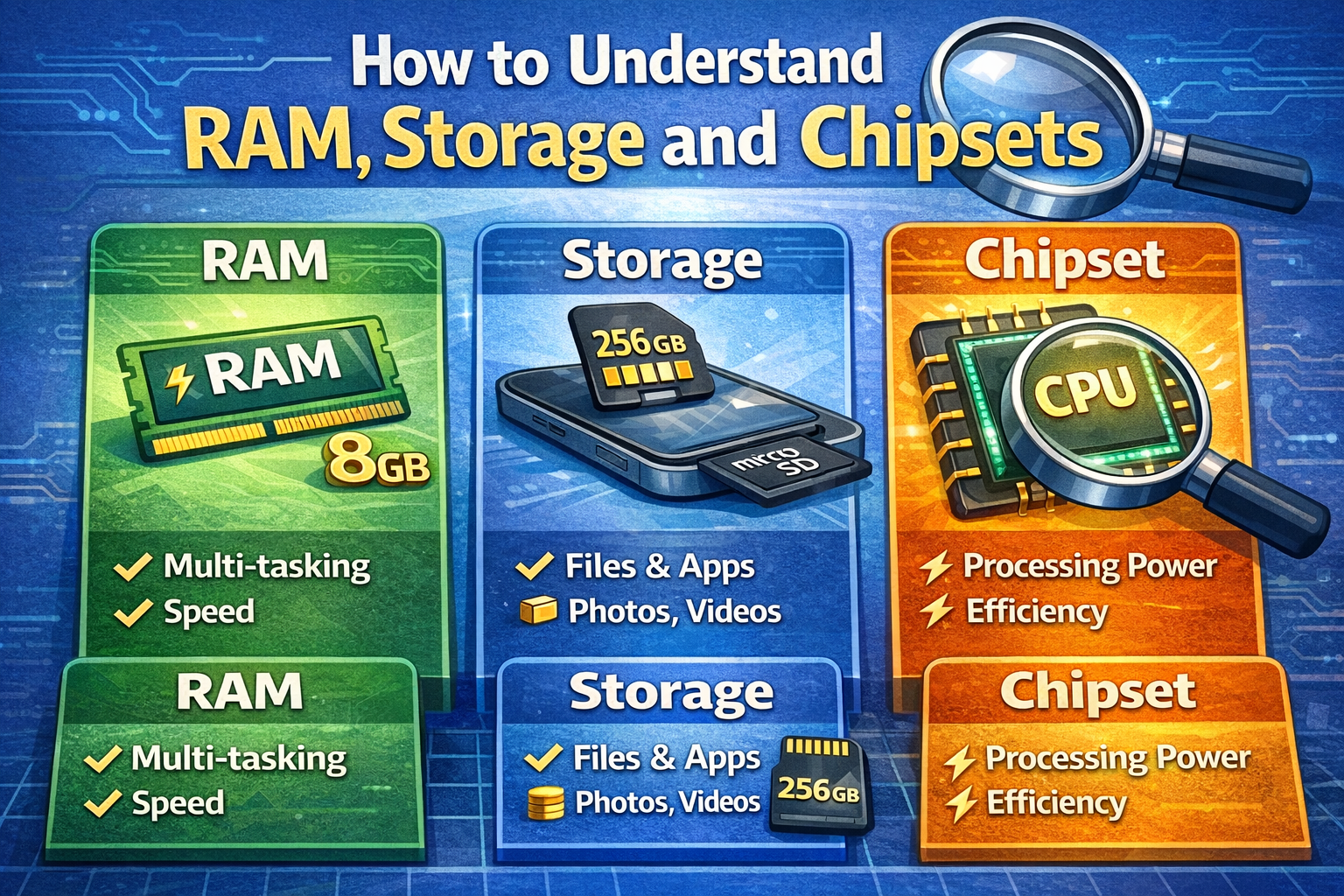
A beginner-friendly explanation of RAM, ROM/storage and chipsets so you can read spec sheets with confidence.
Comparison Advice
- Compare final checkout price, not only MRP.
- Compare the same RAM and storage variant.
- Check return window and warranty activation.
- Shortlist 2-3 alternatives before buying.
Mistakes to Avoid
- Buying only because of high megapixel count.
- Ignoring storage variant and expandable storage support.
- Ignoring charger availability in the box.
- Not checking 5G bands and service support.
Deal Advice
- Wait for bank offers if the phone is newly launched.
- Use exchange only when the old phone value is fair.
- Check both Amazon and Flipkart before final purchase.
- Avoid unknown sellers even if the price looks lower.
What Is RAM and How Much Do You Need?
RAM is where your phone keeps apps and processes that are currently open or recently used. More RAM helps with multitasking and reduces app reloads.
But beyond a point, software optimisation matters more than raw numbers.
- 4 GB – basic usage, light apps, some reloads
- 6 GB – comfortable for most normal users
- 8 GB – better for heavy multitasking and gaming
- 12 GB+ – niche and future-proof, but not mandatory for most people
Storage: ROM, UFS and Free Space
Storage (often called ROM) is where your apps, photos, videos and files live. Running near full storage slows down your phone and can cause issues.
Always leave some breathing room.
- Prefer at least 128 GB if you take lots of photos and videos
- 64 GB is okay for light users but fills quickly
- Look for UFS storage types (like UFS 2.2, 3.1) for faster app loading
- Keep 20–25% of storage free for best performance
Chipsets: CPU, GPU and Efficiency
The chipset is the brain of your phone. It controls performance, gaming, battery and camera processing.
You do not need to memorise every model number. Just know roughly which series are stronger.
Step-by-Step Checklist
- Check the product details, seller information and warranty terms.
- Compare price with at least one alternative before payment.
- Verify return, replacement and service support before accepting delivery.
Godealio buying framework
This guide is built to help Indian buyers make a practical decision on how to understand ram, storage and chipsets without relying only on marketing claims.
Before buying, compare the final checkout price, RAM and storage variant, warranty coverage, bank offer, exchange value and seller rating.
- Check the exact model number and storage variant.
- Prefer higher storage if you plan to keep the phone for 3 years or more.
- Do not judge camera quality only by megapixels.
- Compare final effective price after bank and exchange offers.
Who should use this guide?
This page is useful for buyers who want a simple shortlist, not just a long specification table.
The recommendations are grouped by real-world use cases such as camera, battery, gaming, display, software support and long-term ownership.
Deal checklist before purchase
- Confirm the seller is trusted and return policy is available.
- Check whether charger, cable or case is included in the box.
- Check 5G band support if you use Jio or Airtel 5G.
- Read recent reviews for heating, battery drain and camera issues.
- Compare Amazon and Flipkart prices before ordering.
Frequently Asked Questions
Is more RAM always better?
More RAM helps, but only up to a point. For most people, 6–8 GB is more than enough. It is better to balance RAM with chipset and storage instead of maxing out only one spec.
Why does my phone lag even with 8 GB RAM?
Lag can come from heavy apps, poor optimisation, very full storage or background processes. RAM is just one part of the performance story.
What is the most important check in How To Understand Ram Rom Chipsets?
The most important check is to confirm seller credibility, invoice, warranty and product condition before you complete payment or accept delivery.
Can I rely only on online ratings?
No. Ratings help, but you should also check recent reviews, seller details, return policy and warranty coverage.
What should I do if something looks suspicious?
Do not share OTP or complete payment. Take photos or video proof, contact support and request replacement or cancellation where applicable.
How should I choose from how to understand ram, storage and chipsets?
Start with your budget and main use case, then compare battery, camera, storage, software support, service network and final checkout price.
Should I wait for sale offers before buying?
Yes, if the phone is not urgent. Bank discounts, exchange bonuses and festive sale prices can change the value significantly.
What is the safest storage option for long-term use?
For most users, 128GB is the minimum practical option. Heavy camera, video and gaming users should prefer 256GB or higher.
Related Reading on Godealio
- How to choose the right phone in 2026
- Compare phones
- Latest mobile offers
- All mobile guides
- All mobiles
- POCO X7 5G Glacier Green 8GB RAM 128GB ROM Review (2026): Should You Buy It in India?
- vivo T4 5G (Emerald Blaze, 8GB RAM+128GB Storage) Review (2026): Should You Buy It in India?
- Motorola Edge 70 (Bronze Green, 8GB RAM, 256GB Storage) Review (2026): Should You Buy It in India?
- Motorola Edge 70 (Lily Pad, 8GB RAM, 256GB Storage) Review (2026): Should You Buy It in India?
- Nothing Phone (3a) Pro 5G (Grey, 12GB RAM + 256GB Storage) Review (2026): Should You Buy It in India?
- OnePlus Nord 2T 5G (Jade Fog, 12GB RAM, 256GB Storage) Review (2026): Should You Buy It in India?
More Guide Details
Featured
false