
Apple Intelligence vs Galaxy AI
A practical India-focused guide comparing Apple Intelligence and Galaxy AI to help buyers understand which AI ecosystem is better for productivity, photography, privacy and long-term value.
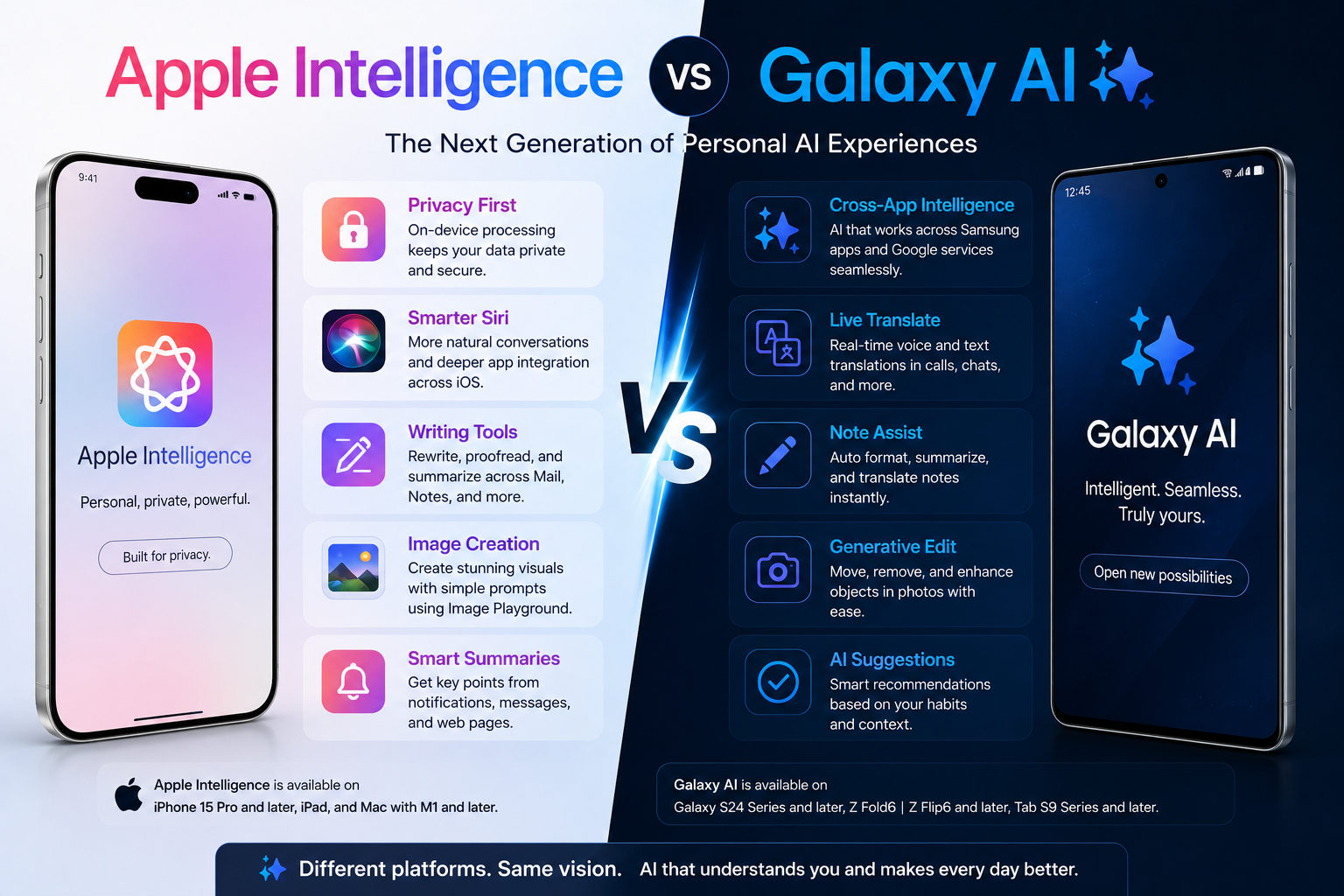
Apple Intelligence and Galaxy AI are transforming modern smartphones, but they focus on different strengths. Apple prioritizes privacy, on-device processing and ecosystem integration, while Samsung's Galaxy AI focuses on productivity, translation, photo editing and cross-device experiences. This guide explains the real-world differences, strengths, limitations and buying considerations for Indian smartphone users.
Quick Verdict
Main rule: Choose Apple Intelligence if privacy and Apple ecosystem integration matter most. Choose Galaxy AI if you want more AI tools, translation features and productivity-focused functionality today.
Best for: Buyers deciding between premium Samsung Galaxy and Apple iPhone devices.
Best by Use Case
Privacy
Apple Intelligence
Translation
Galaxy AI
Photo Editing
Galaxy AI
Apple Ecosystem
Apple Intelligence
Productivity
Galaxy AI
Long-Term Device Support
Tie
Comparison Advice
- Do not buy a phone based only on AI marketing.
- Camera hardware, battery, processor and software support remain more important.
- Apple Intelligence works best inside the Apple ecosystem.
- Galaxy AI currently offers more visible everyday AI features.
- Both ecosystems continue receiving major AI upgrades every year.
Mistakes to Avoid
- Buying an iPhone only for AI features if you use Windows and Android devices.
- Ignoring ecosystem compatibility.
- Paying extra for AI features you rarely use.
- Assuming all AI features work offline.
- Ignoring privacy settings for cloud-based AI tools.
Deal Advice
- Compare AI features alongside camera quality and battery life.
- Consider ecosystem costs such as watches, tablets and laptops.
- Check long-term software support before upgrading.
- Focus on daily usage instead of AI marketing claims.
Simple Explanation
- Apple Intelligence is Apple's AI platform built into iPhone, iPad and Mac.
- Galaxy AI is Samsung's AI platform available on Galaxy smartphones, tablets and wearables.
- Both aim to make phones smarter through AI-powered productivity, camera and communication features.
Different AI Philosophies
- Apple Intelligence focuses heavily on privacy and on-device processing.
- Galaxy AI focuses on delivering practical AI tools immediately.
- Apple prefers gradual integration while Samsung rapidly introduces new features.
- Both approaches have advantages depending on user priorities.
Privacy Winner
- Apple Intelligence processes many tasks directly on the device.
- Private Cloud Compute provides additional privacy protection.
- Apple places strong emphasis on minimizing data collection.
- Galaxy AI also includes privacy controls but relies more heavily on cloud services for some features.
Productivity Winner
- Galaxy AI currently offers stronger productivity features.
- Live Translate works across calls and messages.
- Note Assist provides summaries and formatting.
- Browsing Assist summarizes webpages and articles.
- Interpreter Mode is useful for travelers and business users.
Camera AI Comparison
- Galaxy AI offers Generative Edit, object removal and advanced image enhancement.
- Apple Intelligence focuses on smarter Photos search and editing workflows.
- Samsung currently provides more visible AI editing tools.
- Actual camera hardware remains more important than AI features alone.
Writing and Communication Tools
- Apple Intelligence integrates deeply into system-wide writing tools.
- Users can rewrite, summarize and proofread text across apps.
- Galaxy AI provides writing assistance, translation and summaries.
- Both ecosystems significantly improve productivity.
Siri vs Galaxy AI Assistant Experience
- Apple is rebuilding Siri with deeper AI integration.
- Galaxy AI often leverages Google Gemini and Samsung services.
- Gemini currently offers broader conversational AI capabilities.
- Apple's long-term vision is tightly integrated device intelligence.
Who Should Choose Apple Intelligence?
- iPhone users invested in the Apple ecosystem.
- Privacy-conscious buyers.
- MacBook, iPad and Apple Watch users.
- Users who value seamless cross-device experiences.
Who Should Choose Galaxy AI?
- Android users seeking practical AI tools.
- Business professionals needing translation and productivity features.
- Content creators using AI photo editing.
- Users who prefer customization and flexibility.
Buying Impact
- AI should not be the only reason to choose a smartphone.
- Compare display, battery, processor, camera and ecosystem value.
- Choose Apple if ecosystem and privacy matter most.
- Choose Samsung if AI functionality and flexibility matter most.
Frequently Asked Questions
Which is better: Apple Intelligence or Galaxy AI?
Neither is universally better. Apple Intelligence excels in privacy and ecosystem integration, while Galaxy AI currently offers more practical AI tools.
Which AI platform has better photo editing?
Galaxy AI currently offers more advanced generative editing and object removal features.
Which AI platform is better for privacy?
Apple Intelligence generally has the stronger privacy-focused architecture.
Which AI platform is better for productivity?
Galaxy AI currently offers more productivity-focused features such as translation, summaries and note assistance.
Do I need internet for these AI features?
Some features work on-device while others require cloud processing and internet connectivity.
Should I upgrade phones only for AI?
No. Consider camera, battery, performance, software support and ecosystem benefits alongside AI features.
Related Reading on Godealio
- Best AI Phones in India
- Compare Phones
- Best Camera Phones
- Latest Mobile Offers
- All Mobile Reviews
- All Guides
- Gemini AI vs Apple Intelligence
- Apple Intelligence Features Explained
- Apple iPad Air Review (2026): The Best Value Premium Tablet with Apple Intelligence
- Apple iPhone 16 (Pink, 128 GB) Review (2026): Worth Buying in 2026?
- Apple iPhone 17 vs iPhone 16: display, camera, battery, AI, performance & best iPhone to buy
- Apple MacBook Air M5 Review (2026): thin-and-light productivity
More Guide Details
Featured
false